
What Is the Ex-Dividend Date?
The ex-dividend date determines whether a stock buyer is entitled to the next announced dividend. In general, an investor who buys the stock before the ex-dividend date receives the upcoming dividend. An investor who buys on or after that date does not receive it.
What the Ex-Dividend Date Means

A dividend is a distribution to eligible shareholders. The ex-dividend date separates trades that include the right to the upcoming dividend from trades that do not.
- Buying before the ex-dividend date: The buyer generally qualifies for the next dividend.
- Buying on the ex-dividend date: The buyer generally does not qualify for the next dividend. The seller receives it instead.
- Buying after the ex-dividend date: The buyer generally does not qualify for that dividend.
This date applies to the upcoming dividend only. It does not guarantee that a company will declare dividends in the future.
Why the Ex-Dividend Date Matters
Investors may see the ex-dividend date in a dividend announcement, brokerage account, company notice, or financial calendar. Understanding it helps explain which party in a stock trade is entitled to an announced dividend.
The date is useful for interpreting dividend eligibility. It should not be treated by itself as a reason to buy or sell a stock.
How the Ex-Dividend Date Works
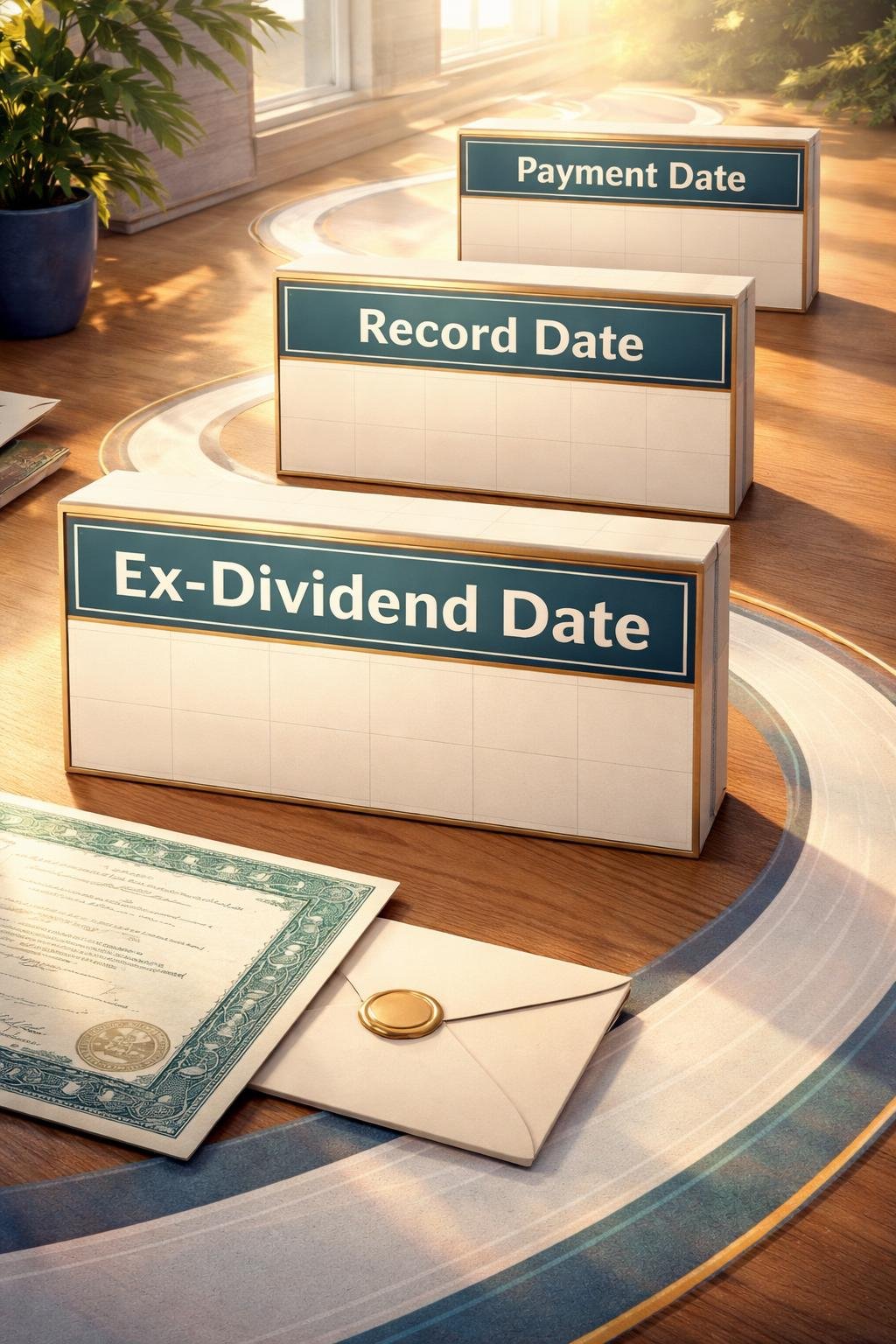
A company establishes a record date for a dividend. The ex-dividend date determines how stock purchases around that record date affect eligibility for the distribution.
For stocks, the ex-dividend date is generally the record date. When the record date is not a business day, the ex-dividend date is generally one business day earlier.
Different timing rules can apply to a dividend worth 25% or more of the stock’s value. Special timing also applies to stock dividends. Because these situations do not necessarily follow the usual pattern, investors should verify the applicable dates through current official information.
Hypothetical Ex-Dividend Date Example

Hypothetical example: Assume an imaginary company announces that Wednesday will be its ex-dividend date. These dates and details are illustrative and do not describe a real company or distribution.
| Action | General result |
|---|---|
| An investor buys shares on Tuesday. | The purchase occurs before the Wednesday ex-dividend date, so the buyer generally receives the upcoming dividend. |
| An investor buys shares on Wednesday. | The purchase occurs on the ex-dividend date, so the buyer generally does not receive the upcoming dividend. The seller receives it instead. |
| An investor buys shares on Thursday. | The purchase occurs after the ex-dividend date, so the buyer generally does not receive that dividend. |
The practical distinction is whether the purchase occurs before the ex-dividend date or on or after it.
Related Dividend Dates and Terms
Record Date
The record date is the date used to identify shareholders for a declared dividend. For stocks, the ex-dividend date is generally the record date, or one business day earlier when the record date is not a business day.
Payment Date
The payment date is when the dividend is distributed to eligible shareholders. It is different from the ex-dividend date, which determines eligibility.
Cash Dividend
A cash dividend is a dividend paid in cash to eligible shareholders. Buying before the applicable ex-dividend date generally gives the buyer the right to the upcoming cash dividend.
Stock Dividend
A stock dividend is distributed in shares rather than cash. For a stock dividend, the ex-dividend date is generally the first business day after the dividend is paid. This differs from the usual timing described for many cash dividends.
Common Ex-Dividend Date Misunderstandings

Buying on the date is generally too late. The word “ex” indicates that a trade on that date generally no longer includes the right to the upcoming dividend.
The buyer does not always receive the dividend. When shares are bought on or after the ex-dividend date, the seller generally receives the upcoming dividend instead.
Not every distribution follows the usual schedule. Dividends worth 25% or more of a stock’s value and stock dividends can have different timing rules. Investors should check the official details for the specific distribution.
Frequently Asked Questions
Do I receive the dividend if I buy before the ex-dividend date?
Generally, yes. A purchase before the ex-dividend date generally qualifies the buyer for the upcoming dividend.
Do I receive the dividend if I buy on the ex-dividend date?
Generally, no. If shares are purchased on the ex-dividend date, the seller generally receives the upcoming dividend instead.
Who receives the dividend when shares are sold?
When a buyer purchases shares on or after the ex-dividend date, the seller generally remains entitled to the upcoming dividend.
How does the record date relate to the ex-dividend date?
For stocks, the ex-dividend date is generally the record date. If the record date is not a business day, the ex-dividend date is generally one business day earlier.
When can special rules apply?
Special timing rules can apply to dividends worth 25% or more of a stock’s value and to stock dividends. For a stock dividend, the ex-dividend date is generally the first business day after payment. Check current official information when an exact date or rule is important.
Key Takeaway

The ex-dividend date determines eligibility for the next dividend. Buying a stock before this date generally qualifies the buyer for the dividend, while buying on or after it generally means the seller receives the dividend instead. Special distributions and stock dividends may follow different timing rules.
References
- Source: Ex-Dividend Dates: When Are You Entitled to Stock and Cash Dividends | Investor.gov. URL: https://www.investor.gov/introduction-investing/investing-basics/glossary/ex-dividend-dates-when-are-you-entitled-stock-and.
Disclaimer
This article is provided for general educational and informational purposes only. It is not investment, financial, legal, or tax advice, and it is not a recommendation or solicitation to buy, sell, hold, or avoid any security or financial product. Financial information, company information, market conditions, fees, rules, regulations, and platform details can change. Investing involves risk, including the possible loss of principal. Verify important current information through relevant official sources and consider your own circumstances, objectives, and risk tolerance before making financial decisions.
Image Notice: Images may be AI-generated educational illustrations provided for visual explanation only. They should not be interpreted as exact representations of real companies, people, products, documents, financial data, or investment outcomes.